






In brief
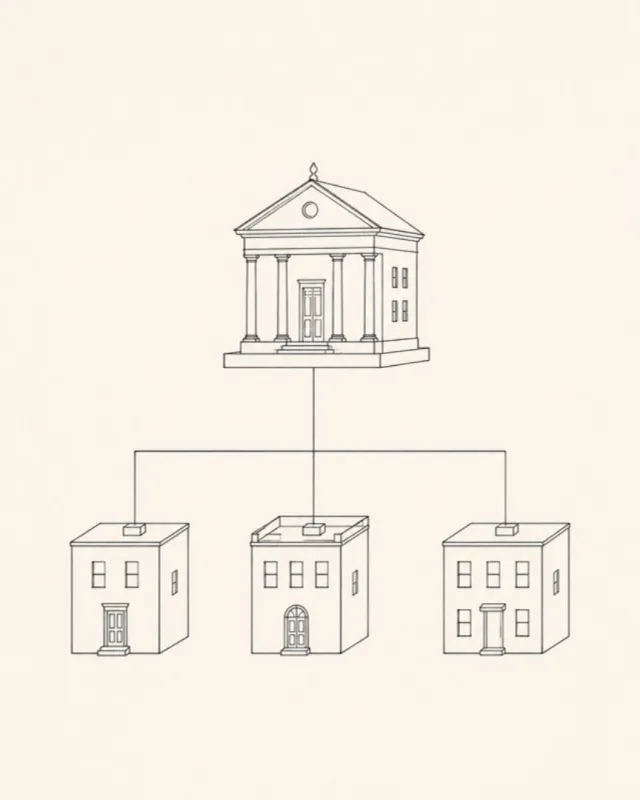
When a developer in Dubai runs into difficulties or insolvency, the main protection for an Off-plan buyer is the project's Escrow account: under Law No. 8 of 2007, each project has a separate account, the funds in it are intended only for its construction, and the developer's creditors cannot attach them. Alongside this, registration of the transaction in the interim register (Oqood) anchors the right to the unit, and a project that has stalled or been cancelled goes to a special tribunal that can order a refund from the Escrow account or transfer the project to another developer. This protection applies only to money that reached the Escrow account; a payment made outside it becomes an ordinary debt of the developer, collected in insolvency proceedings under the federal Bankruptcy Law.
Key takeaways
- 1A separate Escrow account for each project, whose funds are protected from attachment for the developer's debts (Article 9 of Law 8/2007).
- 2Bankruptcy is a ground for striking the developer off the developers' register (Article 17 of Law 8/2007), and when a project will not be completed, the escrow agent acts with DLD towards completion or refund (Article 15).
- 3An unfinished or cancelled project goes to the special tribunal under Decree 33/2020, which can order a refund from the Escrow account or transfer the project to another developer.
- 4A payment that did not reach the Escrow account is not protected in this way. In such a case the buyer is an ordinary creditor in proceedings under Federal Decree-Law 51/2023 (in force since 1.5.2024).
- 5Warning signs: a request to pay outside the Escrow account, discounts for early payment, repeated delays and a status of review towards cancellation.
The question "what happens to my money if the developer goes bankrupt?" is one of the most common among Israelis who are considering or have already made an off-plan purchase in Dubai. The answer depends less on the developer's situation and more on where your money is and at what stage the project is. This guide explains the layers of protection that Dubai law creates, where they end, how to identify a developer in difficulty early, and what to do if it has already happened.
The short answer
If you paid into the project's Escrow account, the money is intended for the construction of the project only, and the developer's creditors cannot attach it. If the project stalls or is cancelled, the special tribunal under Decree No. 33 of 2020 can order a refund from the account or transfer the project to another developer. If you paid outside the Escrow account, you are ordinary creditors of the developer, and there the risk is much higher.
Why do developers run into difficulties, and why is this especially dangerous Off-plan?
Off-plan, buyers fund a substantial part of the construction in advance, so the developer's difficulties affect them directly. The familiar causes are a slowdown in sales, rising construction costs, financing difficulties or disputes with contractors, and sometimes also a concentration of several projects with one developer. The Dubai legislature responded to this in two ways: separating each project's funds in its own Escrow account, and creating a dedicated forum for projects that have stalled.
What the law says: the layers of protection for an Off-plan buyer
The protection is not a single clause but several mechanisms that work together. The table summarises them, with the limitation of each.
| Mechanism | Source in law | What it gives | Where it ends |
|---|---|---|---|
| An Escrow account for each project | Articles 7 and 9 of Law 8/2007 | The funds are intended for the construction of the project only and cannot be attached for the developer's debts | Only for money deposited in the account; money already released for construction has already "turned into concrete" |
| Supervision of the account | Articles 10 and 11 of Law 8/2007 | A registered escrow agent, ongoing reports to DLD and audit | Supervision is not a guarantee that the project will be completed |
| Emergency mechanism | Article 15 of Law 8/2007 | When a project will not be completed, the escrow agent consults with DLD and acts towards completion or refund | Depends on the balance in the account |
| Striking off the developer | Article 17 of Law 8/2007 | Bankruptcy, cancellation of a licence or failure to start construction within 6 months are grounds for striking off the register | Striking off does not in itself return money |
| Oqood registration | Article 3 of Law 13/2008 | Registration of your right to the unit in the interim register; a sale that was not registered is void | Registration of a right to a unit not yet built |
| Full refund on cancellation | Article 11(b) of Law 13/2008, as amended by Law 19/2020 | A final, reasoned RERA cancellation requires a refund of all payments | The actual refund depends on the funds available |
| The special tribunal | Decree 33/2020 | Exclusive jurisdiction over unfinished and cancelled projects, including instructions to the escrow agent, appointment of auditors and transfer to another developer | Does not apply to projects within DIFC |
What happens after completion also matters: under Article 14 of Law 8/2007, after the completion certificate is received, the escrow agent retains 5% of the account and releases it to the developer one year after the units have been registered in the buyers' names. This is a small cushion, not full insurance.
Where does your money stand? A map by type of payment
The same buyer may hold several types of payments, each in a different legal position. It is worth doing this mapping before any step:
| Type of payment | Legal position when the developer is in difficulty | The main route |
|---|---|---|
| Payment into the Escrow account not yet released to the developer | Segregated and protected from attachment by the developer's creditors | The escrow agent and DLD; the special tribunal |
| Payment into the Escrow account released for construction according to progress | Invested in the project; the value lies in the partly built unit | Completion of the project, by the developer or a replacement developer, or a refund by decision of the tribunal |
| Direct payment to the developer outside the Escrow account | An ordinary debt of the developer | A proof of debt in the insolvency proceedings, and sometimes a complaint of misuse of funds |
| Fees paid to DLD | Paid to the authority and not to the developer | Case-by-case review; not certain to be refunded |
| Brokerage commission | Paid to the broker and not to the developer | According to the brokerage agreement |
Hence the practical rule: the larger the share of your money in the first and second rows, the better your position. A buyer who paid everything into the Escrow account and whose unit is registered in Oqood is in a very different place from a buyer who paid a "deposit" into a marketer's account. On the latter case see I paid a deposit and there is no SPA yet: is the money at risk.
What happens in a developer's bankruptcy proceedings?
The insolvency of Mainland companies, and of companies in free zones that have no insolvency law of their own, is governed by Federal Decree-Law No. 51 of 2023 on Financial Restructuring and Bankruptcy. According to a review by King & Spalding, the law entered into force on 1.5.2024, replaced Decree-Law No. 9 of 2016, and proceedings are conducted in a dedicated bankruptcy court. In preventive composition proceedings, claims against the debtor are stayed for three months from the date of the decision.
The meaning for the buyer: funds deposited in the Escrow account remain segregated and earmarked for the project, because the law excludes them from attachment. Other claims against the developer, such as repayment of money paid outside the Escrow account or compensation for delay, join the proceedings like those of any creditor. The exact relationship between the bankruptcy court and the special tribunal for unfinished projects, which under Article 10 of Decree 33/2020 excludes the jurisdiction of other courts in matters within its jurisdiction, is not settled in the text we examined, and in such a case a specific review by a local lawyer is required.
The Escrow account releases money to the developer according to construction progress. If you paid 40% and construction has progressed 30%, a substantial part of the money has already been invested in the project. In such a case the way to obtain value is sometimes completion of the project, by the developer or by a replacement developer, and not a full cash refund.
How do you identify a developer in difficulty before it is too late?
- A request to pay into an account other than the project's Escrow account, or a discount for "direct" payment.
- Offers to bring payments forward in exchange for a large discount.
- Repeated delays in the timetable, and a gap between what the developer reports and the completion percentage reported to the regulator.
- Repeated changes to the payment plan or the specification.
- Many resales of units in the project at a price lower than the original price.
- A project under review towards cancellation.
- Claims by contractors or suppliers against the developer, insofar as they are known.
What to do now - step by step
- Do not make any further payment outside the Escrow account, even if the developer asks, and do not stop paying into the Escrow account without advice, because stopping may trigger Article 11 against you.
- Map the payments: how much was paid, when, and into which account. Separate payments into the Escrow account from any other payment.
- Verify the Oqood registration in your name and the unit details.
- Find out the project's status with the regulator: completion percentage, and whether it is classified as unfinished, under review towards cancellation or cancelled.
- Find out whether insolvency proceedings have been opened and in which forum, and what the deadlines for filing proofs of debt are.
- File the claim in the right forum: the special tribunal for an unfinished or cancelled project; the insolvency proceedings for debts not covered by the Escrow account. Sometimes both.
- Organise with other buyers with care: shared information helps, but each buyer needs to preserve his or her personal rights and documents.
- Consider a completion offer by a replacement developer if the tribunal transfers the project, and compare it with a refund.
- Consider a complaint of misuse of funds if funds did not reach the Escrow account. Under Article 16 of Law 8/2007, misuse of project funds is an offence punishable by imprisonment and a fine of at least 100,000 dirhams.
And what if the apartment has already been handed over?
After handover and registration of a Title Deed in your name, the property is yours, and the developer's insolvency no longer threatens it directly. What remains is liability for defects. Under Law No. 6 of 2019 (Article 40), the developer is liable for repairing structural defects in the common property for 10 years from the completion certificate, and for defective installations for one year. When the developer collapses, the ten-year liability of the main contractor and the engineer under the new Civil Code (Federal Decree-Law 25/2025, in force since 1.6.2026) becomes important; it applies to them jointly and severally for collapse and for defects that endanger stability or safety. See Taking delivery of an apartment in Dubai: inspection, defects and developer liability.
How to prevent this in advance
- Check the developer: DLD registration, previous projects, delivery record. See How to check a developer in Dubai before paying.
- Make sure the project is approved and registered before the first payment; a contract for a project that has not been approved is void (Article 10 of Law 13/2008).
- Pay only into the project's Escrow account, and check the account number in the official documents and not in a marketer's message.
- Prefer a payment plan linked to engineering milestones, and beware of a high early payment. See Payment plans and Post Handover.
- Spread the risk: do not concentrate the entire investment with one developer.
- Ask for a defined right of cancellation and refund in the SPA if the project does not reach milestones.
Common mistakes
- Believing that "there is Escrow so there is no risk": the Escrow protects money deposited in it and not released, not the success of the project.
- Paying the developer directly in exchange for a discount: takes the money out of the protection of Article 9.
- Stopping payment because of rumours: as long as the contract is in force, this is your breach.
- Applying to an ordinary court or to DIFC in a matter within the jurisdiction of the special tribunal; and a property in Mainland Dubai will not be heard in DIFC even by consent (Hackett v Hania, 2017).
- Not tracking deadlines in the insolvency proceedings and missing the filing of a proof of debt.
Before you sign / how we assist
We assist Israeli buyers in coordination with licensed local lawyers in Dubai. Before the transaction we check the developer, the project approval and the Escrow account, and the clauses in the SPA that determine what happens if the project stalls. When a developer is in difficulty, we map the payments, find out the regulatory status and the open proceedings, and decide with the client where and when to file. See also The project was cancelled: how to get the money back from the Escrow account.
This guide is general information current as of November 2026 and is not legal advice. Insolvency law and its relationship with the special tribunal are complex, and each case is examined on its merits with a licensed local lawyer.
Frequently asked questions
What happens to my money if the developer in Dubai goes bankrupt?
Money you paid into the project's Escrow account is intended only for its construction and cannot be attached for the developer's debts (Article 9 of Law 8/2007). Money paid outside the account is an ordinary debt of the developer, collected in the insolvency proceedings.
Does an Escrow account in Dubai guarantee that I will get all the money back?
Not necessarily. The account releases money to the developer according to construction progress, so part of the money has already been invested in the project. The protection is that the money will be used only for the project and will not be seized by creditors, not that it will be refunded in full.
Who completes a project when the developer collapses?
Under Decree 33/2020, the special tribunal may transfer an unfinished project to another developer. Under Article 15 of Law 8/2007, the escrow agent acts with DLD to complete the project or to refund the depositors.
Which law applies to the bankruptcy of a company in Dubai?
Federal Decree-Law No. 51 of 2023 on Financial Restructuring and Bankruptcy, which entered into force on 1.5.2024 and replaced Decree-Law 9/2016. It applies to Mainland companies and to companies in free zones that have no insolvency law of their own.
If the developer is insolvent, should I stop paying the instalments?
Not on your own initiative. As long as the contract is in force, stopping payment is your breach, and the developer (or whoever replaces it) can open proceedings under Article 11. But do not pay outside the Escrow account either. An orderly decision is needed after reviewing the situation.
What is Oqood and how does it help when the developer is in difficulty?
Oqood is the registration of the Off-plan transaction in the DLD interim register. Under Article 3 of Law 13/2008, a sale not registered in it is void. The registration anchors your right to the unit in a way that does not depend on the developer's records.
The apartment has already been handed over and the developer has collapsed. What about defects?
The developer's liability under Law 6/2019 is hard to enforce when it has collapsed. Beyond that, under the new Civil Code, the main contractor and the engineer are jointly and severally liable for 10 years from handover for collapse and for defects that endanger stability or safety.
How do you know if a developer in Dubai is in difficulty?
Familiar signs: a request to pay outside the Escrow account, discounts for early payment, repeated delays, changes to the payment plan and a status of review towards cancellation. Each of these warrants a review by a local lawyer.
Is there insurance or a compensation fund for Off-plan buyers in Dubai?
We did not find an official source for a general compensation fund for buyers. A claim appearing on brokerage websites, that Law No. 4 of 2026 created such a fund, appears to be wrong, because that law deals with jointly owned housing. The protection anchored in legislation is the Escrow account and the special tribunal.
Can the developer's managers be sued personally?
This is a case-specific question. Law 8/2007 establishes offences, such as misuse of project funds, with imprisonment and a fine of at least 100,000 dirhams, but personal civil liability of managers depends on the facts and the applicable law, and is examined with a local lawyer.
 Read next · 12 min readYour Partner or Client in Dubai Has Stopped Paying - How Do You Sue? Debt Collection Routes, Arbitration and LitigationPartner or client in Dubai not paying? What to do: check the contract, demand letter, payment order, bounced cheque, DIAC arbitration, DIFC, attachment, Israel.Read the guide
Sources
- Dubai Legislation Portal - Law No. (8) of 2007 Concerning Escrow Accounts for Real Estate Development
- Dubai Legislation Portal - Law No. (13) of 2008 Regulating the Interim Real Property Register
- Dubai Legislation Portal - Law No. (19) of 2020 amending Law No. (13) of 2008 (Article 11)
- Dubai Legislation Portal - Decree No. (33) of 2020 Concerning the Special Tribunal for Unfinished and Cancelled Real Property Projects
- King & Spalding - The 2024 UAE Financial Restructuring and Bankruptcy Law: what is new
- Khaleej Times - Dubai's off-plan property rules: can buyers get a refund if a project gets cancelled (22.1.2025)
- DIFC Courts - Hackett v Hania [2017] DIFC SCT 034
- LexisMiddleEast - Federal Decree-Law No. 25 of 2025 (Civil Transactions Law)
- Afridi & Angell - Law No. 6 of 2019 on the Ownership of Common Property in Dubai
- Charles Russell Speechlys - Decennial liability under the new UAE Civil Code, Articles 821-824 (2026)
