






In brief
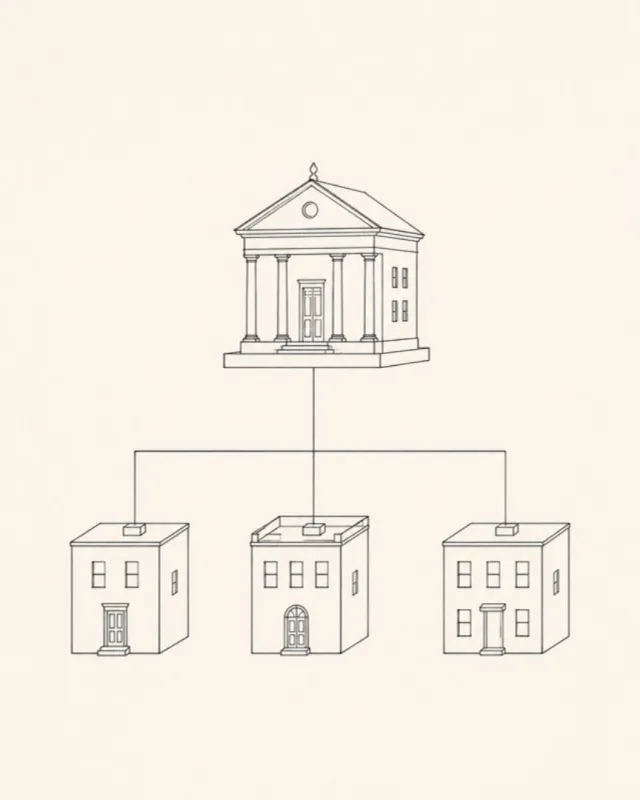
Ras Al Khaimah is an emirate separate from Dubai, with its own registration authority, its own local law and its own court system. Someone who buys an apartment in Ras Al Khaimah is not registered with the DLD, is not protected by Dubai's escrow law and does not litigate in the Dubai courts. Registration takes place at the Ras Al Khaimah Municipality, foreigners may buy only in the Freehold areas designated by the emirate, and according to the Municipality's website the transfer fee is 2% of market value payable by the buyer and 2% payable by the seller (as of November 2026).
Key takeaways
- 1The UAE is made up of seven emirates. What you have learned about the DLD, RERA and Dubai's escrow law does not automatically apply in Ras Al Khaimah.
- 2Registration is handled by the Lands & Properties Sector of the Ras Al Khaimah Municipality, and the regulator of developers and escrow is Ras Al Khaimah's RERA, a body separate from Dubai's RERA.
- 3Foreigners may buy only in the Freehold areas listed on the Municipality's website, including Al Marjan Island, Al Hamra Village and Mina Al Arab.
- 4The emirate's real estate development law was replaced by Law 10/2026, which applies from September 2026, including to existing contracts. A buyer who falls behind on payment gets 30 days to cure, and the developer may deduct up to 40%, 25% or 20% depending on the construction stage.
- 5A large tourism project planned in the area is a marketing forecast, not a contractual right of yours.
Is Ras Al Khaimah "just like Dubai"?
Not legally. Ras Al Khaimah is one of the seven emirates of the United Arab Emirates, and it has its own land registration authority, its own local real estate legislation and its own court system. Part of the law is federal and applies throughout the country, but most of what matters to an apartment buyer - registration, escrow, fees and dispute resolution - is determined at the level of the emirate.
In recent years, projects in Ras Al Khaimah have been marketed intensively in Israel, mainly in the Al Marjan Island area, and often around a large tourism project planned in the area. The problem we see is not the emirate itself, but the assumption that everything said about Dubai also applies here. Anyone who has read about Dubai's escrow law, the DLD's 4% fee or the Dubai courts needs to start over and ask three questions: which authority, which law, which court.
Who registers an apartment in Ras Al Khaimah?
Registration is carried out by the Ras Al Khaimah Municipality, in its Lands & Properties Sector, and not by Dubai's DLD. The legislative basis is Law No. 11 of 2021 on the Real Estate Register in the emirate. According to the Municipality's official service card for registering a sale contract, the service is provided at the Municipality's customer service centre, the stated service time is three working days, and a sale in a Freehold area requires a No Objection Certificate (NOC) from the developer.
The real estate market regulator also operates within the same sector: the Real Estate Regulatory Administration, known as RERA-RAK. The name resembles Dubai's RERA, but it is a different body, established by Ras Al Khaimah Emiri Decree No. 10 of 2014. According to the body's page on the Municipality's website, it registers developers, reviews their cash flow before approval, requires an escrow account to be opened for every project sold off-plan, and requires a developer to obtain written approval before advertising or taking part in an exhibition to promote sales.
Can a foreigner buy an apartment anywhere in Ras Al Khaimah?
No. Foreigners may acquire full ownership (Freehold) only in the areas the emirate has designated for that purpose. The arrangement rests on Emiri Decree No. 19 of 2016 on special authorisation for Freehold ownership, and the Municipality's service card states that UAE nationals and non-Emirati customers are entitled to ownership in Freehold areas.
The areas listed on the Municipality's service card, as of November 2026, are: Al Hamra Village, Mina Al Arab, Al Marjan Island, RAK Central, Julphar Towers and Al Maareedh (plots), and a future beachfront area is also mentioned. The list has changed over the years, so do not rely on a list from a presentation: check with the Municipality that the project's specific plot is in a Freehold area, and that the right to be registered in your name is ownership and not a time-limited right of use.
Does Ras Al Khaimah have an escrow law like Dubai's Law 8/2007?
It has its own escrow arrangement, but it is not Dubai's Law No. 8 of 2007. In Ras Al Khaimah, escrow accounts for real estate development were originally regulated by Emiri Decree No. 22 of 2008. According to the RERA-RAK page, an escrow account is a bank account into which off-plan buyers' payments are deposited so that they are used only for their project, and the trustee must be registered with RERA-RAK. According to the process guide on the Municipality's website, project registration is a precondition for activating the escrow account, and requests to withdraw funds are reviewed and approved by the trustee and RERA.
It is important to know that the legislation here has changed. On 21 July 2026, the Ruler of Ras Al Khaimah issued Law No. 10 of 2026 Regulating Real Estate Development in the emirate. The law came into force sixty days after its publication, that is, in September 2026, and replaced Law No. 12 of 2023. It applies throughout the emirate, including the economic zones of Ras Al Khaimah, and concentrates in the Municipality and its regulatory department powers that were previously divided between a separate committee and RERA-RAK: licensing, project registration, escrow supervision and enforcement. The practical meaning: any article, presentation or opinion written before autumn 2026 may describe law that is no longer in force.
What does the new 2026 law change for an Off-plan buyer?
According to reviews by UAE law firms from October 2026, these are the points that directly concern the buyer. We have not yet found the official text of the law on the Municipality's website, and its implementing regulations have not yet been detailed, so before signing, every point should be verified with a local lawyer.
- A buyer who does not pay: the developer must notify the authority, and the authority examines the breach and the actual completion percentage of the project. The buyer is given 30 days to meet their obligations, and only if the breach continues may the authority allow the developer to terminate the contract.
- How much the developer may deduct on such a termination: up to 40% of the unit price when the project is 60% complete or more, up to 25% when completion is below 60%, and up to 20% when construction has not started for a reason beyond the developer's control.
- Existing contracts too: according to the reviews, the termination provisions apply to all Off-plan sale contracts, including those signed before the law came into force, except for projects that have already received a completion certificate.
- Right to information: the law expressly gives buyers access to all data on the project and on their unit.
- Escrow: escrow is retained, but withdrawals from the escrow account are limited to construction costs and costs the authority considers necessary for completion. The developer must fund at least 20% of the construction cost from its own resources, escrow funds may not be used to pay for the land before a completion certificate, and the Trustee retains 5% of the construction cost for one year after completion.
- Smaller area than sold: if the actual area of the unit is more than 5% smaller than the area sold, the developer must compensate the buyer.
- Changes and marketing: any change to the plans or specifications requires the authority's approval, and marketing agreements with licensed brokers must be registered.
Two practical conclusions. First, if you have already signed a contract and are struggling to pay, the rules that apply to you are probably those of the new law, not those presented to you at the sale. Second, the right to information is a working tool: ask the developer and the authority for the progress data and the escrow account details, and do not settle for an update from the marketer.
For comparison, how the arrangement works in Dubai is explained in Dubai's escrow law (8/2007). Do not assume that the same rules, the same percentages and the same mechanisms apply in Ras Al Khaimah.
Dubai vs Ras Al Khaimah: what actually differs?
| Subject | Dubai | Ras Al Khaimah |
|---|---|---|
| Registration authority | DLD - Dubai Land Department | Lands & Properties Sector of the Ras Al Khaimah Municipality (Law 11/2021) |
| Developer and marketing regulator | Dubai's RERA, Trakheesi advertising permit | RERA-RAK (Emiri Decree 10/2014), written approval before advertising or an exhibition |
| Freehold areas for foreigners | Under Law 7/2006 and Regulation 3/2006 | Under Emiri Decree 19/2016; list on the Municipality's website, including Al Marjan Island |
| Escrow for Off-plan funds | Law 8/2007 | Emiri Decree 22/2008 and Law 10/2026; withdrawals for construction costs only, developer funds at least 20%, 5% retained for one year |
| Termination when the buyer defaults | Article 11 of Law 13/2008, tiers by completion percentage | Law 10/2026: 30 days to cure, then a deduction of up to 40% (completion 60%+), up to 25% (below 60%) or up to 20% (construction not started) |
| Transfer fees (as of November 2026) | 4% transfer fee, plus registration trustee fees and a Title Deed | 2% of market value on the buyer and 2% on the seller, AED 200 for the site plan and AED 200 for the Title Deed |
| Courts | Dubai Courts; the RDC has jurisdiction over rental and jointly owned property disputes; the DIFC does not hear Mainland property cases | Ras Al Khaimah Courts, a separate local judicial system; the route for real estate disputes was updated in 2026 - check with the authority |
Note two practical differences in the fees row. In Ras Al Khaimah the fee is calculated on the market value of the property, not necessarily on the contract price, and it is also imposed on the seller. In other words, someone who buys today and sells in the future will pay a fee on both sides of the cycle. In an off-plan purchase, check separately which fees apply on the initial registration of the unit, and who bears them under the contract.
Which court hears a dispute over an apartment in Ras Al Khaimah?
The Ras Al Khaimah courts, not the Dubai courts. According to the UAE Government's federal portal, Ras Al Khaimah, Dubai and Abu Dhabi have retained independent local judicial systems, which hear matters that have not been transferred to the federal judiciary. The implication: a judgment in Dubai, proceedings before Dubai's RDC or a DIFC jurisdiction clause will not resolve a dispute over a property in Ras Al Khaimah. On the difference between the local courts and the DIFC, see DIFC vs the local courts.
Here too there were changes in 2026. According to a review by a local law firm, Emiri Decree No. 11 of 2026 removed real estate disputes from the jurisdiction of the special committee for real estate and rental disputes, as of 1 September 2026, and they are now heard in the emirate's ordinary courts, with a right of appeal. Before signing, check what the jurisdiction clause in the contract provides, and whether there is an obligation to go first to mediation at the authority.
What applies in all the emirates, including Ras Al Khaimah?
- The new federal Civil Code (Federal Decree-Law 25 of 2025), which came into force on 1 June 2026, applies at the federal level, including to liability for structural construction defects.
- Tax: under Federal Cabinet Decision 49 of 2023, an individual who invests in real estate without needing a business licence is not subject to corporate tax on that income. The decision is federal and also applies in Ras Al Khaimah.
- The tax treaty between Israel and the UAE applies to the whole country, in force from tax year 2022. An Israeli resident reports and is taxed in Israel on rent and on capital gains, and the absence of tax in the UAE means there is no foreign tax to credit.
- Golden Visa is a federal programme. Which conditions apply to a property in Ras Al Khaimah, who approves the valuation and for how many years - check with the Federal Authority for Identity and Citizenship (ICP) before relying on it. A property does not "come with a visa" unless the conditions are actually met.
The large tourism project: why it is not a clause in the contract
Much of the marketing to Israelis relies on an expectation: a large tourism project planned in the area will bring tourists, raise prices and increase rents. Perhaps. But that is a forecast, not a right. The developer selling you an apartment is usually not the body building the tourism project, and makes no commitment regarding it. If the project is delayed, changes or does not open, you will have no claim against the developer just because a picture of it appeared in the presentation.
So separate two things: what the developer commits to in the contract (unit, specification, handover date, payment schedule, escrow), and what you are told about the area. Any promise of a return, guaranteed rent or a buy-back must be in writing, signed by an identified entity and backed by something. On how to check such promises, see I was promised a guaranteed return in Dubai - the principles are the same in Ras Al Khaimah.
What to check before signing for an apartment in Ras Al Khaimah?
- The developer: that it is registered with RERA-RAK, and who stands behind it. The method of checking is similar to the one described in a background check on a developer in Dubai, but the register is Ras Al Khaimah's.
- The project: that it is registered with the Municipality, that it has approval for off-plan sale, and that the plot is in a Freehold area.
- The escrow account: the account number, the name of the trustee bank, and that the payments in the contract are directed to it and not to the account of the marketer or of a related company.
- Initial registration: when and how the unit is registered in your name in the Municipality's register before completion, and who pays the fee.
- The contract: handover date, compensation for delay, what happens if you fall behind on payments, governing law and jurisdiction clause. On the clauses themselves, see reviewing SPA clauses.
- The marketing permit: whether the developer has RERA-RAK approval to advertise, and who exactly the marketer speaking to you in Israel is.
- Remote signing: the emirate has Law No. 2 of 2022 on remote real estate transactions. Check in advance how the signing will be carried out, and if a power of attorney is needed - how it will be authenticated. The UAE is not a party to the Apostille Convention, and an Israeli document is authenticated at the Israeli Ministry of Foreign Affairs and at the UAE Embassy.
- The Israeli side: source of funds, transfer of the money, reporting to the Israel Tax Authority and planning the future sale.
Common mistakes Israelis make in Ras Al Khaimah
- Searching for the project on the DLD website. It will not appear there, and that means nothing, neither good nor bad. The check is done with the Ras Al Khaimah Municipality.
- Relying on "just like Dubai". Dubai's termination percentages, fees and escrow mechanisms are not the law here.
- Reading an old guide. The development law and the courts' jurisdiction over real estate disputes changed in 2026.
- Paying into an account that is not the project's escrow account.
- Pricing the tourism project into the price as if it were certain.
- Forgetting the future sale fee imposed on the seller based on market value.
Before you sign / how we assist
Before signing for an apartment in Ras Al Khaimah, it is advisable that someone who represents only you checks the developer, the project registration, the escrow account and the contract, under the current law of the emirate and not on the basis of what is known about Dubai. We do this in coordination with locally licensed lawyers in the UAE, and we connect the transaction to the Israeli side: tax, reporting, transfer of funds and remote signing. We have no office in the UAE, and we do not recommend projects or promise returns. Our role is to make sure your decision is made on the basis of what is written and registered.
This guide is general information as of November 2026 and is not legal advice, tax advice or an opinion on a particular transaction. The law in Ras Al Khaimah was updated in 2026, and every detail - areas, fees, procedures - should be verified with the authority and a local lawyer before signing.
Frequently asked questions
Can an Israeli buy an apartment in Ras Al Khaimah?
Yes, in the Freehold areas designated by the emirate. According to the Ras Al Khaimah Municipality's service card, non-Emirati customers are entitled to ownership in areas such as Al Marjan Island, Al Hamra Village and Mina Al Arab. Check that the specific plot is in such an area.
Where is an apartment in Ras Al Khaimah registered?
At the Ras Al Khaimah Municipality, in the Lands & Properties Sector, and not with Dubai's DLD. An off-plan apartment is first recorded in an initial register, and a Title Deed is issued after the project is completed.
Does Dubai's escrow law apply to a project in Ras Al Khaimah?
No. Ras Al Khaimah has its own escrow arrangement, which began with Emiri Decree 22/2008 and was updated by Law 10/2026. Under the new law, withdrawals from the escrow account are limited to construction and completion costs, and the developer must fund at least 20% of the construction cost itself.
What happens in Ras Al Khaimah if I miss a payment to the developer?
Under Law 10/2026, the developer must apply to the authority, which examines the breach and the project's completion percentage. You get 30 days to cure. If you do not, the contract may be terminated, and the developer may deduct up to 40% of the price (project 60% complete or more), up to 25% (below 60%) or up to 20% (construction not started).
Does Ras Al Khaimah's new law also apply to a contract I signed before 2026?
According to reviews by local law firms, the termination provisions of Law 10/2026 apply to all Off-plan sale contracts, including earlier contracts, except for projects that have already received a completion certificate. Verify with a local lawyer based on the specific contract.
How much does a transfer of ownership cost in Ras Al Khaimah?
According to the Municipality's service card, as of November 2026: 2% of market value on the buyer, 2% on the seller, AED 200 for the site plan and AED 200 for the Title Deed. The fees on initial registration of an off-plan apartment are checked separately.
Is Al Marjan Island a safe investment?
There is no safe investment, and we do not recommend areas or projects. Al Marjan Island is a Freehold area according to the Municipality's list. A tourism project planned in the area is a forecast, not a commitment by the developer selling you an apartment.
Where do you sue a developer in Ras Al Khaimah?
In the Ras Al Khaimah courts, which are a judicial system separate from Dubai's. According to a review by a local law firm, since September 2026 real estate disputes are heard in the ordinary courts and not by a special committee. Also check the jurisdiction clause in the contract.
Does an apartment in Ras Al Khaimah qualify for a Golden Visa?
The Golden Visa is a federal programme, but the conditions, the valuation approval and the visa's validity for a property in Ras Al Khaimah must be checked with the ICP before the purchase. Do not assume that the property "comes with a visa".
Is tax payable in Israel on an apartment in Ras Al Khaimah?
Yes. An Israeli resident reports and is taxed in Israel on rental income and on profit on sale. In the UAE, an individual investing in real estate is not subject to tax under Cabinet Decision 49/2023, so there is no foreign tax to credit.
 Read next · 8 min readA Business Bank Account in Dubai for an Israeli-Owned Company: What the Bank Checks and How to PrepareOpening a business bank account in Dubai for an Israeli-owned company: KYC, beneficial owners, source of funds, authenticating Israeli documents, mistakes.Read the guide
Sources
- RAK Municipality (Sanad) - ZL13 Real Estate Sale Contract service card
- RAK Municipality - Real Estate Regulatory Administration (Lands & Properties Sector)
- RAK Municipality (Sanad) - Project development journey: developer and project registration, escrow
- RAK Municipality - Law No. (12) of 2023 on Regulating Real Estate Development (official PDF, incl. preamble listing Law 11/2021, Law 2/2022, Emiri Decrees 22/2008, 10/2014, 19/2016)
- UAE Government Portal - The federal judiciary (local judicial departments of Dubai, Abu Dhabi, RAK)
- Al Tamimi & Company - Ras Al Khaimah's new real estate development law (October 2026)
- ADG Legal - RAK's New Real Estate Development Law: What Developers With Active Projects Should Review (16.10.2026)
- Legal 500 - RAK's New Real Estate Development Law (26.10.2026, republished from ADG Legal)
- Al Tamimi & Company - Jurisdiction over real estate disputes returns to RAK Courts
- UAE Ministry of Finance - Cabinet Decision on natural persons (49/2023)
- Dubai Legislation Portal - Law No. 8 of 2007 Concerning Escrow Accounts (Dubai side of comparison)
