






In brief
A building permit for a new building in Greece (οικοδομική άδεια) is filed electronically only, in the e-Adeies system of the Technical Chamber of Greece (ΤΕΕ), by an engineer appointed by the owner, and is reviewed by the building service (ΥΔΟΜ). Before filing, you check whether the land is buildable and what its building rights are, whether it is classified as forest, whether it is subject to archaeological restrictions, and whether it has existing construction that has not been regularised. Under Law 4495/2017 the permit is generally valid for four years, and for buildings of more than 5,000 sq m, six years.
Key takeaways
- 1Filing is electronic only, in the e-Adeies system, and only an engineer with access to the ΤΕΕ systems can enter the file.
- 2Law 4495/2017 divides permits into three categories by size, location and use. A project in an archaeological area, near the coast or outside the town plan usually falls into the strictest category.
- 3Pre-approval (προέγκριση) is generally optional, but it is mandatory for a new building or an addition that brings the built area above 3,000 sq m. The pre-approval is valid for two years.
- 4The important checks are done before buying the land: building rights, forest classification in the forest maps, archaeological restrictions, existing illegal construction and restrictions on non-EU buyers in border areas.
- 5The government has announced the transfer of the building services from the municipalities to a new body within the Hellenic Cadastre. As of November 2026, you need to check which body is competent in the project's area.
An Israeli developer looking at land in Greece usually asks two questions: how much can be built on it, and how long it will take to get a permit. The answer to both depends on the checks carried out before signing for the land, not after. This guide walks through the path from the land to the building permit (οικοδομική άδεια) for a new building: who files, what is checked, which additional approvals may be required, and what the law says about timelines and the validity of the permit.
The guide deals with new construction. Renovating an existing property is subject to different rules, which we set out in the guide to renovating an old property in Athens and Thessaloniki.
Who issues a building permit in Greece, and where is it filed?
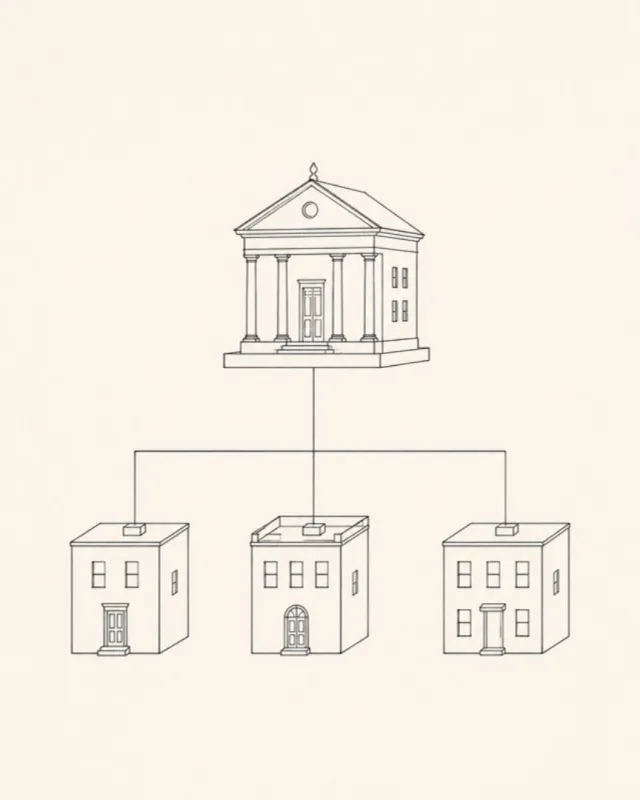
The permit is issued by the building service (Υπηρεσία Δόμησης, ΥΔΟΜ), and filing is done only electronically in the e-Adeies system of the Technical Chamber of Greece (Τεχνικό Επιμελητήριο Ελλάδας, ΤΕΕ). The legal framework is Law 4495/2017, mainly Articles 35 to 42. According to the Greek government's procedures portal, the permit is also accessible through gov.gr, and if the electronic system is not working, the file can be submitted at a citizen service centre (ΚΕΠ), which forwards it to the building service.
It is important to know that this structure is in the process of changing. In November 2025 the Greek government approved a bill that transfers the issuing of building permits and the supervision of construction from the municipalities to a new body to be established within the Hellenic Cadastre (Ελληνικό Κτηματολόγιο). According to the reports, the original timetable included partial operation in June 2026 and full operation at the beginning of 2027. As of November 2026 we have not verified the status of the legislation and its actual implementation, so in every project you need to check which body is competent in the area where the land is located.
Who files the application: the owner or the engineer?
The application belongs to the owner or to whoever has a lawful right in the land, but only an engineer enters the file into the system. According to the procedures portal, the engineer logs in with their access credentials for the ΤΕΕ systems, and the application is accompanied by declarations on the appointment of the designers, the acceptance of responsibility and the supervision. In practice, a foreign developer cannot file an application themselves, and choosing the engineer or the design firm is one of the first legal decisions in the project.
It is therefore worth setting out the relationship with the engineer in a written agreement: the scope of design and supervision, the timetable, liability for design errors, professional liability insurance, and what happens if the engineer stops working on the project. The difference between the roles of the engineer, the lawyer and the notary in a Greek transaction is explained in the guide to the notary, the lawyer and the engineer.

What should be checked in the land before buying it for a project?
You check whether it may be built on, how much and what. In Greece the first distinction is between land within an approved town plan (εντός σχεδίου) and land outside the town plan (εκτός σχεδίου). Within the plan, the building rights derive from the building terms of the area (όροι δόμησης): the building coefficient (συντελεστής δόμησης), that is, the ratio between the permitted built area and the plot area, the coverage percentage (κάλυψη), the permitted height and setbacks from the plot boundaries. Outside the plan the rules are stricter, and according to a professional guide from 2025 the minimum plot area for building is generally 4,000 sq m, with a frontage of at least 25 metres onto a recognised public road and few exceptions.
Beyond the building rights, there are several checks, each of which can on its own stop a project:
| Check | What to look for | Why it matters to the developer |
|---|---|---|
| Building rights | Building coefficient, coverage, height, permitted uses and minimum plot area | They determine how many sq m can be sold, and therefore the land price that makes sense to pay |
| Forest classification | The status of the plot in the Hellenic Cadastre's forest maps (δασικοί χάρτες) | A part classified as forest generally cannot be built on, and this may reduce the area below the minimum |
| Archaeology | Whether the plot is within an archaeological site, near a monument or in a traditional area | Approval of the antiquities service may be required, and sometimes trial excavations that delay the works |
| Ownership and registration | Registration in the Hellenic Cadastre (Κτηματολόγιο), boundaries, encumbrances and third-party rights | The permit file includes ownership documents and a topographic survey linked to the national coordinate system |
| Existing construction | Structures or building violations that have not been regularised | Part of the documents for the permit is proof of the legality of the existing structures |
| Border area | Whether the plot is in an area where purchase by non-EU buyers requires approval | Affects the acquisition structure and the timetable even before the design |
On building violations in an existing property and the engineer's certificate required in every transaction, see the guide to building violations in Greece. On the purchase restrictions in border areas, see the guide to buying in border areas.
Forest classification is checked in the official forest maps, available in the Hellenic Cadastre's map service, and not according to what the seller says. A plot part of which is classified as forest can still receive a permit for the part that is not forest, but only if that part on its own meets the area and frontage requirements.
Which additional approvals may be required?
Article 40 of Law 4495/2017 requires the file to include the approvals of other services and bodies, “where they are required”. The law itself does not list them, because they depend on the location and type of the project. In new residential projects, the common questions are these:
- Antiquities. The code for the protection of antiquities was ratified by Law 4858/2021. On an archaeological site or near a monument, approval of the regional antiquities service (Εφορεία Αρχαιοτήτων) is required, and according to decisions published on the Ministry of Culture's website, the approval may be subject to conditions and supervision, and progress on the works may depend on the results of trial excavations.
- Forest. If there is doubt about the plot's classification, the check with the forest service and the forest maps should be closed before the purchase.
- Protected areas, coasts and streams. Under Article 36 of the law, works near the coast or a defined stream, and works in traditional or historic areas, fall into the strictest permit category.
- Infrastructure. The documents for the file also include a gas plan approved by the gas supplier, if gas is used, and drainage and plumbing plans.
According to professional reports, a 2021 legislative amendment provided that approvals of third-party bodies for the permit will also be issued electronically through e-Adeies. Implementation varies from body to body, so it is worth asking the engineer in advance which approvals will be filed in the system and which will be required separately.
What are the three categories of building permit in Greece?
Article 36 of Law 4495/2017 divides permits into three categories, according to area, location, use, size and environmental impact. The category determines the level of review and the accompanying approvals.
| Category | Examples from Article 36 | Meaning for the developer |
|---|---|---|
| 1 (the strictest) | Residential buildings over 2,000 sq m and special buildings over 1,000 sq m within a town plan; construction outside the town plan in certain cases; works on monuments, in archaeological, historic or traditional areas; works near the coast or a stream | More approvals and a more thorough review. In a project of this size it is worth planning for extra time |
| 2 | Construction in settlements predating 1923 that have no approved boundaries; certain regularisations and changes of use | Review by the building service before issue |
| 3 (the most lenient) | Residential buildings up to 2,000 sq m and special buildings up to 1,000 sq m within an approved town plan; residential additions; swimming pools and retaining walls | Automatic issue after a complete filing, and a retrospective sample check |
What are the steps from the land to the permit?
The following steps are based on Articles 35, 38 and 40 of the law and on the description of the procedure in the government procedures portal. The actual order varies according to the category and the accompanying approvals.
- Feasibility check before purchase. Building rights, forest classification, antiquities, ownership and registration, and existing construction. It is preferable for the check to be carried out by an engineer acting for you and not for the seller.
- Topographic survey and coverage diagram. The topographic survey is linked to the national coordinate system and registered in the Hellenic Cadastre.
- Pre-approval (προέγκριση). Under Article 35 it is generally optional, but it is mandatory for a new building or for additions that bring the built area above 3,000 sq m, and in other cases set out in the law. At this stage the building service checks the ownership documents, the topographic survey, the coverage diagram and the legality of the existing structures, and determines which plans and approvals will be required.
- Plans and approvals. Architectural plan, structural plan, building services plans, energy performance plan, works schedule, drainage plan, fire safety plan and safety plan where required, and a construction waste management plan, together with the approvals of the other bodies.
- Payments and filing. Under Article 40, proof of payment of the levies to the state, to the social insurance institution (e-ΕΦΚΑ) and to the municipality is attached, as well as proof of payment of the engineers' fees.
- Issue and review. Under Article 38, in categories 1 to 3 with pre-approval, the permit is issued automatically after a complete filing, and the building service reviews the file within three working days. With automatic issue, the building service must review at least 30% of the permits by sample check, and a complaint requires a review in every category.
- Commencement of works and supervision. Before the works begin, a notice of commencement of construction works is filed, and the supervising engineer oversees the execution.
How long does it take to get a permit, and how long is it valid?
The law sets short deadlines for the administrative stages, but the actual timetable is determined mainly by the design time and by the approvals of other bodies. The project's financial planning should therefore be based on the engineer's estimate for the specific project, and not on the deadlines in the law.
| Subject | What the law provides (as of November 2026) | Source |
|---|---|---|
| Issue of pre-approval | Within 10 days of the electronic filing, if there are no deficiencies. The time for correcting deficiencies is not counted | Article 35 |
| Correcting deficiencies in pre-approval | Within two months | Article 35 |
| Incomplete application | Rejected and archived if not issued within six months of filing | Article 35 |
| Validity of pre-approval | Two years | Article 42 |
| Validity of building permit | Four years from issue; six years for buildings of more than 5,000 sq m | Article 42 |
| Extension after expiry | Possible by revising the permit, according to the construction stage completed, and after an inspection by a building inspector | Article 42 |
A bank financing a project in Greece will check that the permit is valid for the entire construction period, and that the timetable allows the frame to be completed before the permit expires. Under Article 42, the extension terms are better when the frame has been completed by the expiry date. This point is worth incorporating into the contractor agreement and the financing plan.
What does this mean for the land purchase contract?
It means that the planning risk should be written into the contract. When buying land for a project, the customary way to protect the developer is to tie payment to planning progress: a small first payment, and the main payment only after the checks have been closed, and sometimes only after pre-approval. Legally this is done through a preliminary agreement with conditions precedent, an option for the design period, or a “combination deal” (land-for-units deal) with the landowner.
- Representations by the seller on the building rights, the absence of forest classification and the absence of proceedings or building violations, with a compensation mechanism if it turns out otherwise.
- A condition precedent of pre-approval or of approval by the antiquities service, where there is concern about such a restriction.
- An obligation on the seller to cooperate in submitting documents and signing the topographic survey.
- A deadline for satisfying the conditions, and what happens to the money paid if they are not satisfied.
On a deal structure in which the landowner receives apartments instead of money, see the guide to combination deals and joint ventures with a landowner. On the agreement with the contractor, see the guide to the construction contract in a project abroad.
And what needs to be checked on the Israeli side?
Israeli developers usually develop a project in Greece through a dedicated Greek company. The decision on the company structure, the relationship between the partners and reporting to the Israel Tax Authority should be made before the land is purchased. It is also worth reading the guide to the founders' agreement, the guide to development project financing, and, if you are raising money from investors in Israel, the guide to raising money from Israelis. On the sale of new apartments and VAT, see the guide to VAT on a new apartment in Greece.
What should be done before signing for the land, and how do we support this?
Before signing, you commission a feasibility check by an engineer acting for you, check the ownership and registration in the Hellenic Cadastre, and translate the findings into conditions in the purchase contract. We review the deal structure and the contract, coordinate the legal due diligence with lawyers licensed in Greece and with the engineer, and make sure that the permit timetable fits into the financing and construction agreements.
This article is general information as of November 2026 and is not legal advice for a specific case. Planning and building law in Greece changes frequently, and the powers of the building services are undergoing reform. Before any commitment to land, it is worth checking the current text of the law with a lawyer and an engineer licensed in Greece.
Frequently asked questions
Who files an application for a building permit in Greece?
The application belongs to the owner or to whoever has a lawful right in the land, but only an engineer with access credentials for the ΤΕΕ systems enters the file into the e-Adeies system. A foreign developer therefore always works through an engineer or a design firm in Greece.
How long is a building permit in Greece valid?
Under Article 42 of Law 4495/2017, a building permit is valid for four years from issue, and for buildings of more than 5,000 sq m, six years. A pre-approval is valid for two years. After expiry, an extension can be requested on terms that depend on the construction stage completed.
Is pre-approval (προέγκριση) mandatory?
Generally not. Under Article 35 of the law, pre-approval is optional, but it is mandatory for a new building or for additions that bring the built area above 3,000 sq m, and in other cases set out in the law. Even when it is optional, it makes it possible to identify problems in ownership and the surveys early.
Can you build on a plot part of which is classified as forest?
Generally you can build only on the part that is not classified as forest, provided that this part on its own meets the area and frontage requirements. The classification is checked in the official forest maps, and not according to what the seller says.
What happens if there are antiquities on the plot?
On an archaeological site or near a monument, approval of the regional antiquities service is required under Law 4858/2021. The approval may include conditions and supervision, and progress on the works may depend on the results of trial excavations. This is a reason to check the matter before buying the land.
 Read next · 9 min readBuying an Old Property to Renovate in Athens and Thessaloniki: Renovation Permits, Preservation, Timelines and PitfallsBuying an old apartment to renovate in Athens or Thessaloniki? Which works need a permit, small-scale works approval, listed buildings, timelines and pitfalls.Read the guide
Sources
- Law 4495/2017, Article 35 - Pre-approval of a building permit (Taxheaven)
- Law 4495/2017, Article 36 - Categories of building permits (Taxheaven)
- Law 4495/2017, Article 38 - Procedure for issuing a building permit (Taxheaven)
- Law 4495/2017, Article 40 - Documents for a building permit (Taxheaven)
- Law 4495/2017, Article 42 - Validity of a building permit (Taxheaven)
- Greek government procedures portal (Mitos) - Issue of building permits (e-Adeies)
- Greek government procedures portal (Mitos) - Pre-approval of a building permit
- CNN Greece - Building services move to the Cadastre, permits go digital (27.11.2025)
- Law 4858/2021 - Code for the protection of antiquities and cultural heritage (Forin)
- Elxis - Forestry land in Greece: building restrictions and exceptions
- Elxis - Building restrictions and regulations in Greece (2025)
