






In brief
An Israeli developer developing a project in Sofia does so almost always through a Bulgarian company, because a resident of a country that is not a member of the Union cannot acquire land in his own name. The project goes through a fixed chain of planning, a design permit, detailed design, a building permit, supervision and a use permit under the Spatial Development Act, and each stage can delay the timetable. The legal preparation - the holding structure, the examination of the land, the construction contracts and the sales mechanism - is carried out before the land is bought, not after.
Key takeaways
- 1An Israeli cannot acquire land in Bulgaria in his own name, so a development project is almost always built through a Bulgarian company (OOD).
- 2The permit chain: a detailed plan, a design permit, detailed design by registered designers, a building permit, close supervision, and finally a use permit or a commissioning certificate depending on the building's category.
- 3A building may not be used before it has been lawfully put into use; a building without a use permit is a property that is hard to sell and finance.
- 4A contractor must be registered in the professional register of builders, and its liability for defects continues for years after handover.
- 5On exit through a sale of shares: under the treaty and the MLI amendments, Bulgaria may tax a gain on shares of a company whose value derives mostly from real estate in Bulgaria.
Why are Israeli developers looking at Sofia?
Sofia is a housing market with deep local demand, large new supply and prices that are still low compared with other capitals in the Union. According to a Colliers report of July 2026, about 7,630 apartments under construction were offered for sale in the city, at an average asking price of about 2,070 euros per sq. m. excluding VAT, and in 2025 about 22,280 apartment transactions were carried out in Sofia, about 27% of them financed by a mortgage.
Prices are rising quickly: according to the National Statistical Institute, in the first quarter of 2026 housing prices in Sofia rose by 5.8% compared with the previous quarter. Alongside this, according to Colliers, supply is concentrated: about 35% of it is in only five districts. For a developer this means competition on location and quality - not only on price.
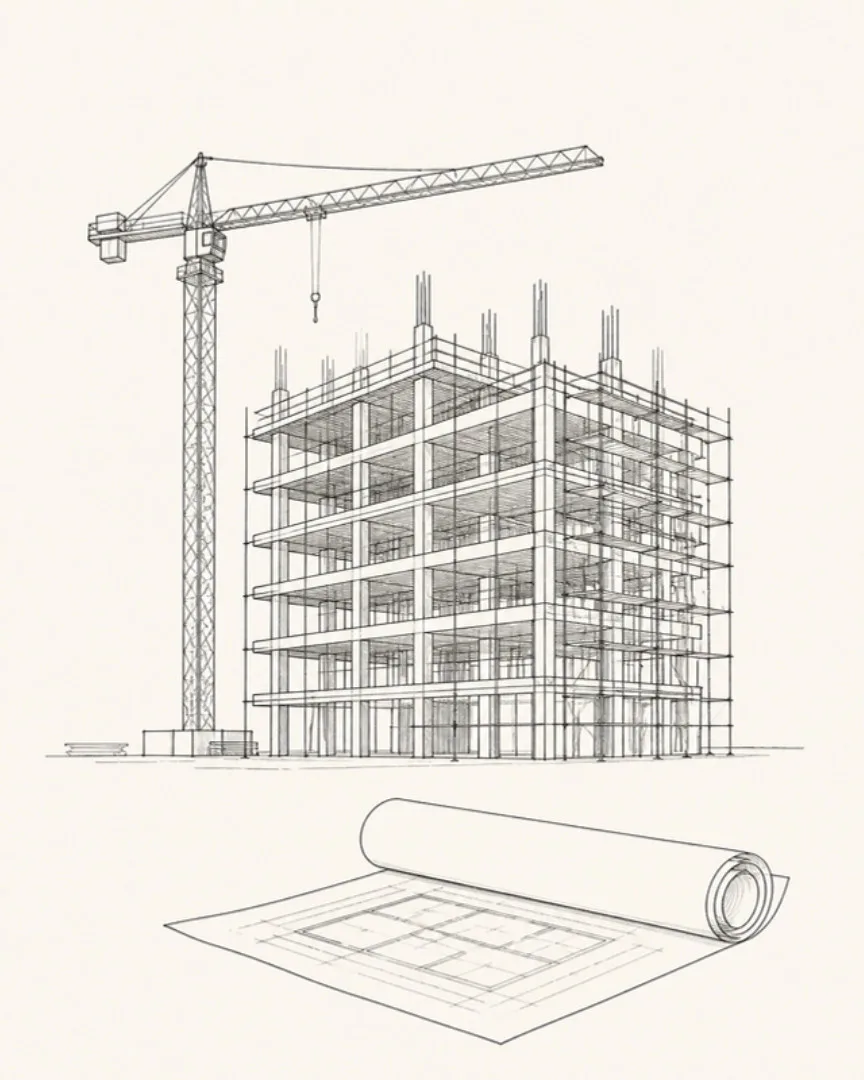
The permit chain: a detailed plan, a design permit, detailed design by registered designers, a building permit, close supervision, and finally a use permit or a commissioning certificate depending on the building's category.
How does an Israeli developer hold land in Bulgaria?
A resident or company from a country that is not a member of the European Union or the EEA, including Israel, cannot acquire ownership of land in Bulgaria. Therefore a development project is almost always held through a Bulgarian company, usually an OOD, owned by the Israeli developer - as a wholly controlled company or as a joint venture with partners.
Another route common in the Bulgarian market is a transaction with a landowner who grants the developer a building right over the plot and receives units in the project in return. This structure saves the price of the land in cash, but creates dependence on the owner and requires a detailed contract: what happens if the project is delayed, how the units to be handed over are defined and what the position is on liens in favor of the financing bank.
The holding structure is determined before the preliminary agreement to buy the land. A company set up after signing may require a further transfer of the rights - and another round of transfer tax and fees.
What do you check in the land before buying in Sofia?
Beyond checking ownership and the historical chain of title, described in our legal guide to Bulgaria, land for a project is examined first of all against planning:
- The detailed plan applying to the plot: designation, building rights, height, density and building lines. A plot without an approved detailed plan for the project you planned may require a long planning process.
- Infrastructure and connections: electricity, water, sewage and road access - and the actual connection times.
- Special restrictions: conservation, heritage sites, green areas and environmental restrictions.
- Claims and neighbors: pending proceedings, right-of-way claims and boundary disputes.
- Match between the register and the cadastre: the plot's area and boundaries as registered against the situation on the ground.
What are the permit stages from planning to a use permit?
The framework is the Spatial Development Act (ЗУТ) and its regulations. The process goes through a fixed chain, and any delay in one link postpones everything that follows:
| Stage | What happens | Who is involved |
|---|---|---|
| Detailed plan | Setting or changing the designation and building rights on the plot | The municipality and the city council |
| Design permit | A document that defines the permitted parameters for design | The chief architect |
| Detailed design | Design of the building under Ordinance No. 4, by designers registered with the chambers of architects and engineers | The developer's design team |
| Coordination and approvals | Utility companies, safety, environment and heritage | The authorities and the utility companies |
| Building permit | Approval of the design and issuance of a permit | The chief architect or the competent authority |
| Execution and supervision | Construction by a registered contractor, under a supervision consultant, with protocols for each stage | Contractor, supervision consultant, designer |
| Putting into use | A use permit (categories I-III) or a commissioning certificate (IV-V) | The National Construction Supervision Directorate or the municipality |
In the Bulgarian market the execution stages are known by their protocols: Act 14 records the completion of the rough structure, Act 15 the completion of construction and its handover, and Act 16 is the committee protocol that determines that the building is fit for use, on the basis of which the use permit is issued for buildings in the higher categories. For buildings in categories IV-V no Act 16 is drawn up, and in its place the authority that issued the building permit issues a commissioning certificate. Your building's category determines which route applies, so it must be established already at the design stage.
The law prohibits using a building before it is lawfully put into use. Apartments handed over before the use permit are a constant source of problems: buyers cannot obtain a mortgage, and sometimes cannot register or connect services in an orderly manner.
What matters in the contract with the contractor and the professional team?
In Bulgaria, except for particularly simple works, only a contractor registered in the professional register of builders kept by the Bulgarian Chamber of Builders may carry out construction works, and only in the field in which it is registered. Subcontractors must also be registered. The contractor, the designer, the supervision consultant and the technical supervisor must carry professional liability insurance.
- Liability for defects: The contractor is liable for defects for five years from acceptance, and alongside this minimum warranty periods set in Ordinance No. 2 apply, counted from putting into use. Longer periods may be agreed, not shorter ones.
- Security: In private projects it is customary to make advance payments conditional on a bank guarantee, a lien or a performance guarantee.
- Wording of the contract: FIDIC contracts are not common in small private projects; a tailored contract is usually used, so the legal drafting is what allocates the risk.
- The supervision consultant: He ensures the lawfulness of the start of works, the completeness of the protocols and conformity with the design - and without him you do not reach a use permit.
Off-plan sales: how do you sell units without opening a legal front?
In Sofia it is customary to sell apartments during construction, with payments according to progress. For the developer this is cheap financing; for the buyer it is a risk. It should not be assumed that Bulgaria has a statutory mechanism of bank accompaniment and guarantees similar to the Israeli Sale Law, so the trust of buyers - and especially of Israeli buyers - is built from the contract and from transparency.
- Present to buyers the building permit, the ownership or building-right documents and the position on liens.
- Tie each payment to a stage protocol that can be verified.
- Define a handover date, compensation for delay and a clear exit mechanism.
- Coordinate in advance with the project's financing bank the release of the lien on each unit sold.
- Draft a uniform and transparent sale document, in a language the buyer understands, that conforms to Bulgarian law.
The sale of new apartments is usually subject to VAT at a rate of 20%, and the contract must state expressly whether the price includes it. A breakdown of transaction costs and taxes on purchase is in our taxation guide to Bulgaria.
How is the profit from the project taxed, and what happens on exit?
A Bulgarian company is subject to corporate tax of 10% on profit, and a dividend distribution to an individual is subject to a 5% withholding. In Israel, a dividend from a foreign company is taxable, subject to a credit for the Bulgarian tax under the treaty, and it is worth examining in advance the Israeli rules on a controlled foreign company as well.
On exit there are two main routes: a sale of the units or the building from within the company, or a sale of the company's shares. A sale of shares saves the local transfer tax and the registration fee, but under the tax treaty between Israel and Bulgaria, as amended within the MLI, Bulgaria may tax a gain from the sale of shares of a company where, during the 365 days before the sale, more than 50% of its value derived from real estate in Bulgaria. That is, a sale of shares is not a way to exit the Bulgarian tax net.
A checklist for a developer before buying land in Sofia
- Set up or prepare the Bulgarian company that will hold the land, and set a founders' agreement.
- Check the detailed plan and the actual building rights, and obtain a professional view on the feasible project.
- Carry out a full legal, technical and environmental due diligence on the plot.
- Build a realistic timetable for permits, with a margin for delays.
- Choose a registered contractor and a supervision consultant, and draft contracts with security.
- Plan the sales route and the buyers' documents before marketing.
- Plan the tax structure and the exit in both countries.
Before signing: how we accompany a development project
As developers ourselves, we accompany projects from the first examination of the land: the holding and partnership structure, due diligence, the design and construction contracts, the sales mechanism for buyers and coordination with the accountants in Bulgaria and in Israel. We work with local lawyers, designers and supervision consultants, and serve as a single point of responsibility toward all of them - so that the business timetable is built on the actual planning timetable, and not the other way around.
The contents of this article are general information only, as of October 2026, and do not constitute legal advice, tax advice or an investment recommendation. Before any decision, obtain advice tailored to the circumstances of the project.
Frequently asked questions
Can an Israeli buy land in Sofia?
Not in his own personal name. Residents of countries that are not members of the Union or the EEA cannot acquire ownership of land in Bulgaria. The accepted solution is a Bulgarian company owned by the developer, which acquires the land.
What is Act 16 in Bulgaria?
Act 16 is a committee protocol that determines that a building is fit for use, on the basis of which a use permit is issued for buildings in categories I-III. For buildings in categories IV-V a commissioning certificate is issued in its place. A building may not be used before it has been lawfully put into use.
Does selling the company's shares exempt from tax in Bulgaria?
Not necessarily. It saves transfer tax and registration fees, but under the treaty with Israel, as amended in the MLI, Bulgaria may tax a gain from the sale of shares of a company whose value derived mostly from real estate in Bulgaria in the year before the sale.
Must a contractor in Bulgaria be registered?
Yes. Except for particularly simple works, only a contractor registered in the professional register of builders may carry out construction works, and only in its field of registration. Subcontractors must also be registered.
 Read next · 10 min readSelling Property in Bulgaria: Capital Gains Tax, Exemptions and Transferring the Funds to IsraelHow much tax an Israeli pays selling an apartment in Bulgaria, why the three- and five-year exemptions usually do not apply, how to report and transfer the money.Read the guide
Sources
- Chambers and Partners - Construction Law 2026, Bulgaria
- BTA / Colliers - 7,630 apartments under construction listed for sale in Sofia (July 2026)
- National Statistical Institute - Housing price statistics, Q1 2026
- Israel-Bulgaria Convention for the avoidance of double taxation (synthesized text with MLI)
- RSM Bulgaria - Holding of Bulgarian real estate (corporate tax, dividends)
- PwC Worldwide Tax Summaries - Bulgaria, Individual, Other taxes
The information in this guide is general in nature and does not constitute legal or tax advice on any specific transaction. Every transaction is assessed on its own facts.