


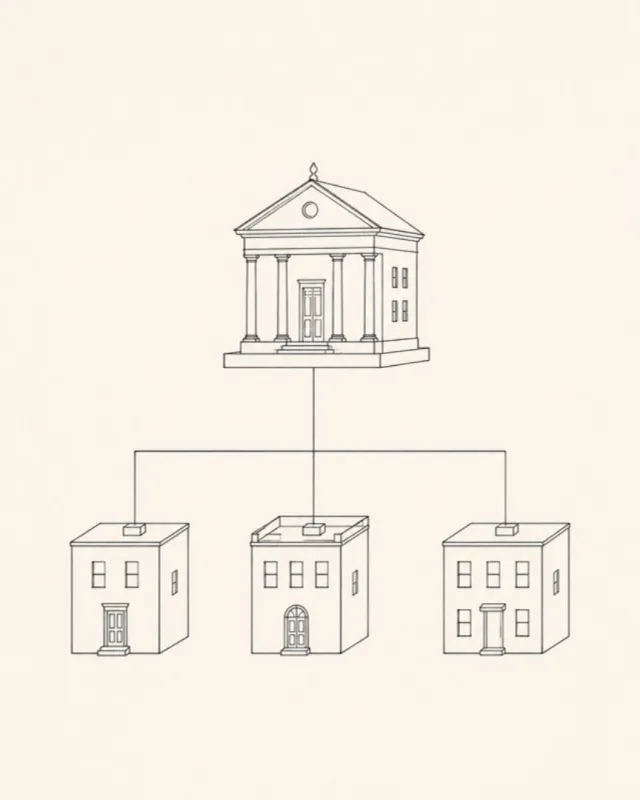




The property tax shown in the listing is the seller's bill. Yours begins in the January after you buy.
“Five thousand one hundred and six dollars.”
Doron read me the number off his phone on Monday evening, and I could hear him scrolling down, as if a correction were waiting at the bottom of the file. The management company in Orlando had sent him the bill as a PDF, with a single line: “Please approve payment by the end of November to receive the discount.” In his Excel sheet, in the row labelled “property tax,” there was a different number: 2,940.
“A year ago it was exactly 2,940,” he said. “I checked.”
He really had checked. Doron is fifty-eight, an industrial engineer from Modi'in, and he does not buy anything without a spreadsheet. Before he bought the house in an Orlando suburb, three bedrooms for 293 thousand dollars, he compared seven houses, read the inspection report, asked his insurance agent for three quotes and consulted an accountant familiar with taxation between Israel and the US. The property tax he copied from the listing. The first bill, in November 2025, matched it to the dollar. It was an official figure from a government office, and he had no reason to doubt it.
But that number belonged to the seller.
The seller had lived in the house for twelve years. In Florida, someone whose house is their permanent home is entitled to a partial exemption from property tax, as well as a very low cap on how fast their assessment can rise. After twelve years, the seller's assessment was far below market value. And the law contains one rule that decides almost everything in this story. Under Section 193.1554 of the Florida Statutes, residential property of up to nine units that is not the owner's permanent home enjoys a 10% cap on the annual increase in its assessment. But after a change of ownership, the property is reassessed at its full value on January 1 of the following year. The same applies when control, or more than half the ownership, of a company that holds the property changes hands.
But note that word: permanent. The exemption is for the home you live in. Doron lives in Modi'in, and he rents out the house in Orlando. He is not entitled to that exemption, and he never will be.
The 2025 bill was still based on the situation on January 1, 2025, when the house still belonged to the seller. On January 1, 2026, the county property appraiser looked at a house that had changed hands. No exemption, and a value of 288 thousand dollars.
There was one more document, and it arrived in August. Every summer the county property appraiser sends a notice of the new assessment and the estimated tax, and from the mailing date there are 25 days to file a petition with the county's Value Adjustment Board (Section 194.011). The envelope went to the management company's address. They scanned it into a shared folder, and there it sat until last week. “They send me twenty files a month,” Doron said. “I only open the ones about the rent.”
I asked his accountant in Orlando to check whether a petition would have made sense. The answer was not pleasant, but it was fair: a value of 288 thousand for a house bought for 293 thousand is not an excessive assessment. A petition would have cost money and not brought much down. In other words, the problem was not the appraiser. The problem was the row in the spreadsheet.
Then came Tuesday. In the midterm elections, Florida passed Amendment 3 to its constitution, with about 62% of the vote according to unofficial results, against a required threshold of 60%. The amendment raises the exemption for homeowners who live in their homes to 150 thousand dollars of assessed value in 2027 and to 250 thousand in 2028, on the portion of the tax not earmarked for schools. And for rental properties and second homes, it lowers the cap on the annual increase in assessment from 10% to 5%, starting January 1, 2027. The details will be set in implementing legislation.
“So is this good or bad for me?” Doron asked.
Both. From 2027 his assessment will rise more slowly. But the cap applies to the new assessment, the one that has already jumped to full value, and this year's gap will not come back. And there is something I do not know: when the counties collect much less from homeowners who live in their homes, I have no idea whether they will raise the tax rate for everyone, and if so, by how much. Doron did not vote on Tuesday. He is not an American citizen. But his bill for the coming years was decided there.
What we actually did was modest. He will pay the bill in November and receive the 4% discount the law gives those who pay in that month (Section 197.162), about 204 dollars. The mailing address for county notices was changed to his email address. And when the lease comes up for renewal in February, he will ask the tenant for an extra 150 dollars a month, if the market allows.
The difference, 2,166 dollars a year, ate about 15% of the net yield he had calculated. “I copied the only number in the spreadsheet I didn't check against the source,” he said. “And it was someone else's number.”
What struck me about this story is that Doron did everything right, except for one row that looked the most official. Israeli investors check the roof, the insurance and the tenant, and copy the property tax from the listing, because it looks like a fact rather than an assumption. But the listing shows what the person who lived there paid. Your bill asks who you are.
The question I would ask in your place
- Does the seller enjoy a permanent-residence exemption, and how far below the price I am about to pay is their assessment?
- To which address will the August assessment notice be sent, and who on my side will open it within the 25 days in which a petition can be filed?
- If the property tax in the second year is two and a half times what the listing shows, does the deal still meet the yield I need, or do I ask for a price reduction now?
Stories are based on real situations, with identifying details changed. Not legal advice.
Translated from the Hebrew original. עברית
Related guides
A new story every week, straight to your inbox
Thank you, you are subscribed. The next issue will reach your inbox.
